

Introducing the criticome, the window of becoming in which the developing brain takes in what it carries for life

Criticome: the window of becoming. Five categories of experiential information (sensory, motor, social, cultural, and environmental) become integrated into developing neural architecture during critical periods.
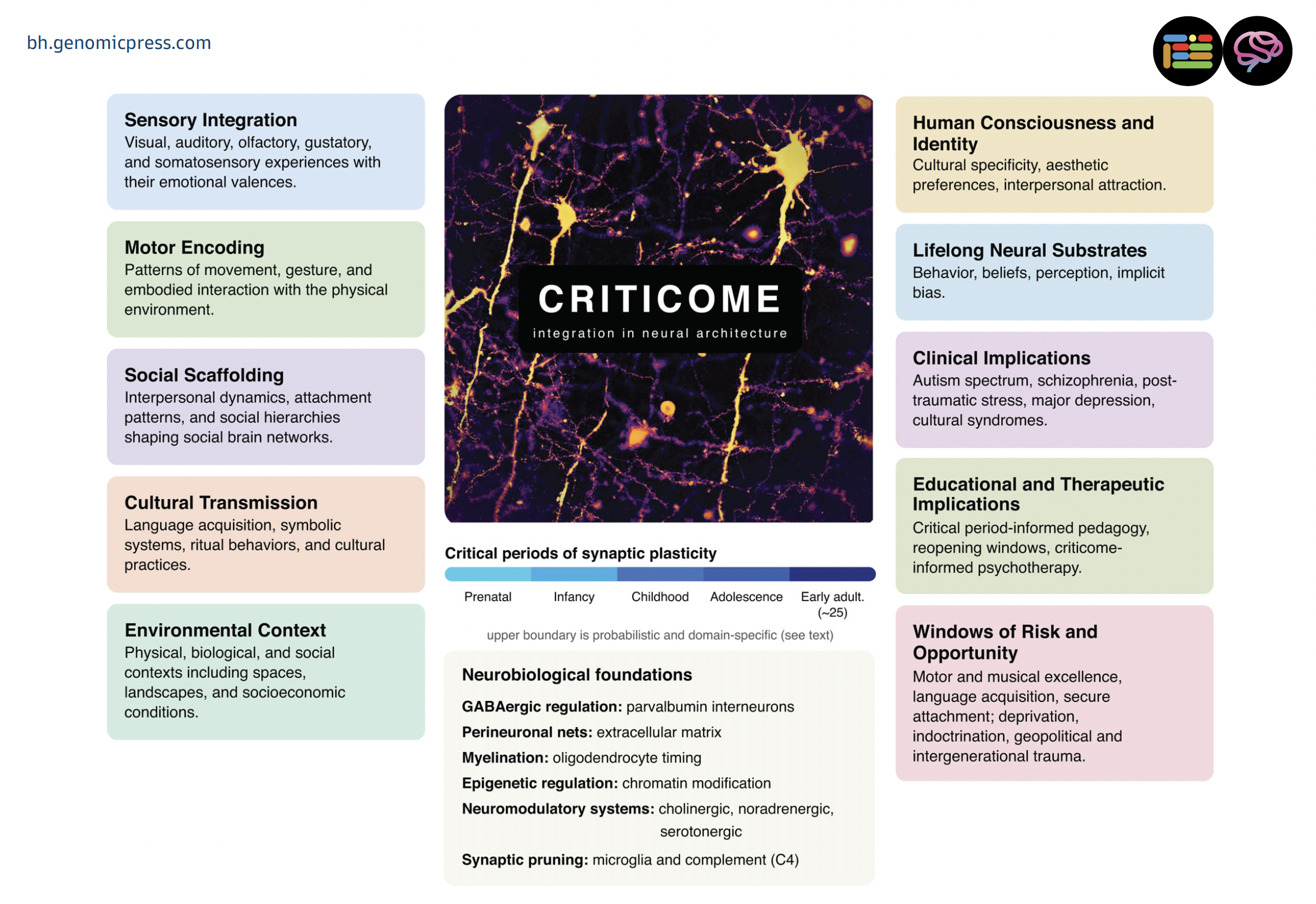
Understanding the criticome. Five categories of experiential information become integrated into developing neural architecture during critical periods, spanning prenatal development through approximately age 25.
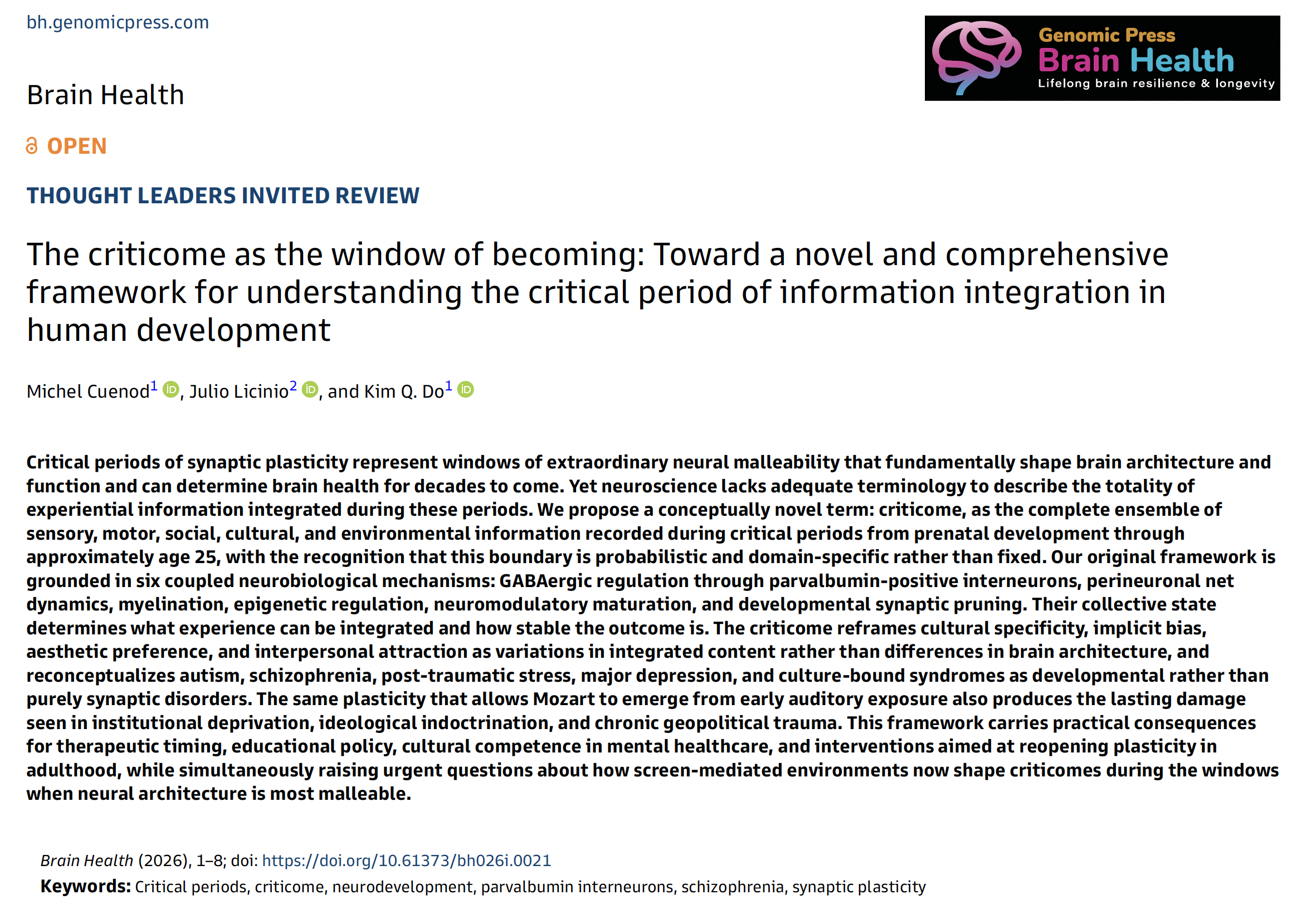
The criticome as the window of becoming: Toward a novel and comprehensive framework for understanding the critical period of information integration in human development
The criticome names the full record of experience a developing brain takes in, and recasts autism, schizophrenia, depression, and trauma as developmental.
That boundary is not a cliff. The review is careful to frame age twenty-five as a population-level approximation rather than a fixed deadline, since the windows close gradually and at different times for different brain systems. Vision and native-language hearing settle in early childhood, while the prefrontal cortex, the seat of judgment and self-regulation, keeps refining itself into the third decade of life. The practical point cuts against a common assumption. A nineteen-year-old brain is not finished, and a twenty-six-year-old is not categorically beyond reach. What enters during these windows becomes load-bearing. What does not enter, or enters wrong, is difficult to add back later.
The synthesis is at its most consequential when it turns the framework toward psychiatry. Autism spectrum disorders, schizophrenia, post-traumatic stress, major depressive disorder, and culture-bound syndromes are recast as developmental rather than purely synaptic conditions. The clinical question shifts. It is no longer only what is broken in the adult brain. It is what could not be integrated, or was integrated incorrectly, during the windows when integration was still possible. Schizophrenia, in this lens, is bound up with disrupted maturation of parvalbumin-positive interneurons, a class of inhibitory brain cell, in the prefrontal cortex during the late adolescent window. Autism reflects altered timing of those windows across multiple sensory and association systems. Early trauma alters stress responsivity for life.
“The data have been telling us for years that schizophrenia is a disorder of development, not a disorder of the adult synapse,” said Dr. Michel Cuenod, co-author at the Center for Psychiatric Neuroscience, Lausanne University. “The difficulty has always been articulating what went wrong, and when. The criticome gives us a frame for that question.”
Major depression receives the review’s most carefully argued case, drawing on a natural experiment by Kenneth Kendler and Lindon Halberstadt. They interviewed fourteen pairs of identical twins, raised together but sharply discordant for a lifetime history of major depression, and asked the twins themselves what had pulled their lives apart. With genotype identical and the childhood home shared, the affected twin almost always carried the weight of a wounding break in a close relationship, sometimes by sheer chance, sometimes steered there by a slightly more impulsive temperament that hardened across decades into a divergent life. The authors call that slow magnification cumulative continuity. The criticome lens places the finding in a mechanistic frame, since the social scaffolding integrated during the long, late-closing prefrontal window is itself load-bearing for adult mood regulation.
The reach of the idea is deliberately wide. “We wrote this for the clinician asking the right questions without quite having the vocabulary,” said Dr. Kim Q. Do, corresponding author at the Center for Psychiatric Neuroscience, Lausanne University. “It is also for the educator wondering why second-language instruction works so much better at five than at fifteen, and for the policymaker trying to understand why early-childhood investment yields the returns it does. They are the same question.”
Six neurobiological mechanisms anchor the framework: GABAergic regulation through parvalbumin-positive interneurons, perineuronal nets that wrap around fast-spiking cells, progressive myelination of cortical circuits, experience-dependent epigenetic regulation, the maturation of neuromodulatory systems, and developmental synaptic pruning. The review treats pruning as a full pillar rather than an afterthought. Up to half of the brain’s cortical connections are eliminated across childhood and adolescence, with immune cells called microglia tagging much of what goes. What is pruned cannot be recovered. What is preserved becomes the substrate of adult thought.
Folk wisdom reached the core of this long before the molecular biologists did. There is an old Brazilian proverb, papagaio velho não aprende a falar, an old parrot does not learn to speak. Hubel and Wiesel demonstrated the same principle in the cat visual system. Language, birdsong, attachment, and the rough geography of moral feeling all run on the same logic. A window opens. A code is absorbed. The window closes. After that, acquisition turns effortful and incomplete.
Critical periods cut both ways. The same machinery that let Mozart emerge from a childhood saturated in harmony is the machinery behind the profound developmental delays documented in children raised in Romanian orphanages. The path from a toddler’s first unsteady steps to Roger Federer on Centre Court rests on motor experience laid down during plastic windows, as does the contemplative cast of mind formed when Lhamo Dhondup was recognized as the Dalai Lama at the age of two and immersed in meditative training from early childhood. The review does not look away from the darker uses. The Nazi Hitlerjugend exploited critical-period plasticity by design, and today’s conflicts are integrating violence and displacement into the criticomes of children in real time, with consequences that will outlive their causes.
It is against that backdrop that the review raises the question of screens, and treats it as an open problem rather than a verdict. Contemporary children and adolescents are absorbing screen-mediated experience at a scale no previous generation has known, during the very windows when the criticome is most malleable. The authors do not claim to know what kind of criticome is being assembled under those conditions. They argue that the question is now urgent, and that the framework gives researchers a way to pose it as a testable empirical problem rather than a moral panic.
One of the review’s most evocative passages is also among its most clinically pointed. The authors set a sentence from James Joyce’s Finnegans Wake beside a sentence from the letters of his daughter Lucia, who was diagnosed with schizophrenia. On the surface the two read alike, full of ruptured syntax, coined words, and associations that jump the rails of ordinary logic. One writer is among the most celebrated novelists of the twentieth century. The other was a patient. Carl Jung, who briefly treated Lucia in 1934, gave the sharpest account on record, describing father and daughter as two people going to the bottom of a river, one falling and the other diving. The criticome offers a neurobiological reading of that asymmetry. Joyce composed from a criticome integrated under intact regulation and then chose, as an adult, to navigate its depths, while Lucia’s late-adolescent prefrontal window closed on a disrupted integration, and the same depths drew her down without her consent.
The authors are careful about what the framework does not do. The criticome is a conceptual framework, not a measurement tool. It does not yet deliver a method for quantifying integrated content in a living brain. The conditions it reframes are varied, and the developmental lens is offered as productive rather than complete. Turning the synthesis into testable interventions will require measurement methods that do not yet exist, and the review says so plainly.
"What we cannot name, we cannot fully grasp. Giving a phenomenon a simple name is the first step toward seeing it, sharing it, and studying it. Until then, it remains scientifically invisible," said Professor Do.
The criticome framework will not settle every dispute it touches, and it is not meant to. What it does is convert a scattered literature into language precise enough to support the next round of experiments. Decades of work on critical periods have given neuroscience the parts. The review offers a name for the whole.
The peer-reviewed invited review in Brain Health, titled “The criticome as the window of becoming: Toward a novel and comprehensive framework for understanding the critical period of information integration in human development,” is freely available via Open Access, beginning 2 June 2026 in Brain Health at the following hyperlink: https://doi.org/10.61373/bh026i.0021.
The full reference for citation purposes is: Cuenod M, Licinio J, Do KQ. The criticome as the window of becoming: Toward a novel and comprehensive framework for understanding the critical period of information integration in human development. Brain Health 2026. DOI: https://doi.org/10.61373/bh026i.0021. Epub 2026 Jun 2.
About Brain Health: Brain Health is a peer-reviewed medical research journal published by Genomic Press, New York. The journal publishes original research, reviews, and perspectives across the full breadth of brain health and longevity, integrating neuroscience, psychiatry, neurology, public health, and the social and behavioral sciences. Brain Health serves as a forum for work that addresses how the brain is shaped, sustained, repaired, and burdened across the lifespan, from molecular and cellular mechanisms through clinical, societal, and policy dimensions.
Brain Health: https://bh.genomicpress.com/
Visit the Genomic Press Virtual Library: https://issues.genomicpress.com/bookcase/gtvov/
Our media website is at: https://media.genomicpress.com/
Our full website is at: https://genomicpress.com/
Ma-Li Wong
Genomic Press
mali.wong@genomicpress.com
Visit us on social media:
X
LinkedIn
Bluesky
Instagram
Facebook
Legal Disclaimer:
EIN Presswire provides this news content "as is" without warranty of any kind. We do not accept any responsibility or liability for the accuracy, content, images, videos, licenses, completeness, legality, or reliability of the information contained in this article. If you have any complaints or copyright issues related to this article, kindly contact the author above.
